Introduction
A young student once stood in front of a classroom, confidently reciting the alphabet while listing scientific words for each letter. Everything went smoothly until the letter Y appeared. The room fell silent. Even the teacher paused for a moment before suggesting “Yolk.” That simple moment sparked curiosity. Why are scientific words starting with Y so difficult to remember?
The truth is that the letter Y isn’t as common in scientific vocabulary as letters like B or C. Yet the few scientific terms that begin with Y are surprisingly important. They appear in biology, chemistry, medicine, astronomy, and environmental science. Some describe tiny structures inside living cells, while others explain natural elements that have shaped our planet.
Let’s explore these fascinating scientific words and uncover the stories behind them.
Y Is Rare but Powerful in Science
The English alphabet contains many letters that dominate scientific language, but Y is one of the rarest. This scarcity makes every Y-word stand out. Rather than being ordinary vocabulary, many of these words represent specialized concepts that scientists rely on every day.
Take yttrium, for example. It sounds unusual, but it plays a significant role in modern technology. This metallic element is found in LED displays, superconductors, and even medical lasers. Most people use devices containing yttrium without ever realizing it.
Another remarkable example is yolk, which most people associate with breakfast. In biology, however, yolk is much more than food. It provides nutrients that help embryos develop inside eggs, making it an essential part of animal reproduction.
These examples remind us that uncommon words often carry extraordinary importance. Like hidden treasures, scientific Y-words may be few in number, but each one opens a door to a fascinating area of knowledge.
Common Scientific Words That Start With Y
When students search for scientific vocabulary beginning with Y, several terms appear repeatedly because of their importance across different scientific fields.
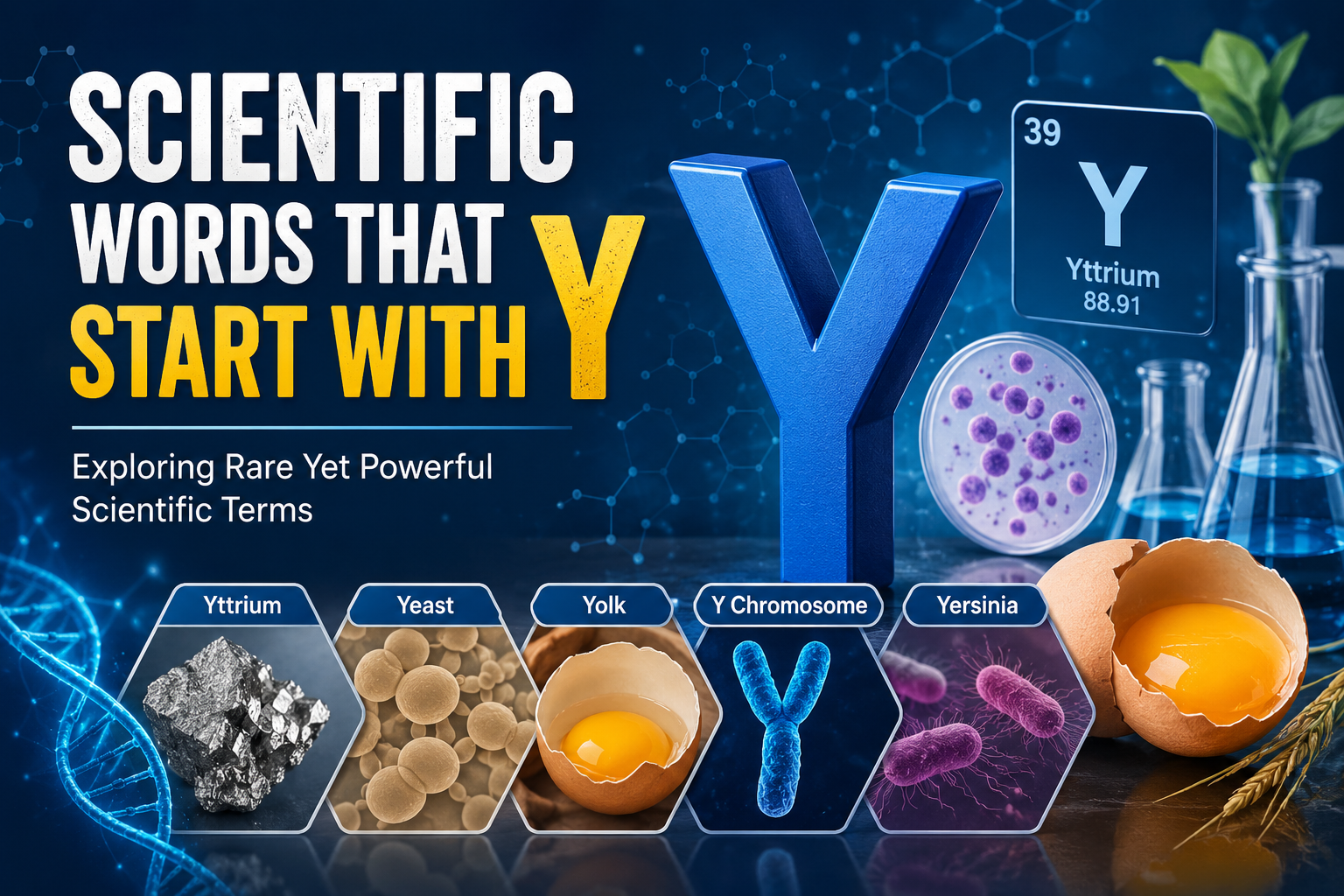
Yttrium is a chemical element with the symbol Y and atomic number 39. Scientists use it in electronics, lasers, and specialized alloys because of its unique physical properties.
Yeast is another familiar scientific word. Although many people know it as an ingredient in bread, yeast is actually a living microorganism belonging to the fungi kingdom. Scientists frequently use yeast in genetics and biotechnology because it grows quickly and behaves similarly to more complex cells.
Then there is Yolk, which serves as the nutrient-rich center of an egg. Biologists study yolk to understand embryonic development and reproductive strategies in birds, reptiles, and fish.
Y chromosome is another essential biological term. It determines male sex characteristics in humans and many other mammals. Researchers continue studying this chromosome to better understand genetics, inherited diseases, and human evolution.
These words may seem unrelated, yet together they demonstrate how one letter connects chemistry, biology, genetics, and nutrition in meaningful ways.
Lesser-Known Y Scientific Terms Worth Knowing
Some scientific Y-words rarely appear in everyday conversations, but they are incredibly valuable in research and education.
One example is Yersinia, a genus of bacteria. Certain species within this group are responsible for serious infectious diseases, making them an important focus of medical research. Scientists study these bacteria to develop better treatments and improve public health.
Another fascinating word is Ylide, a chemical compound used in organic chemistry. Although students often encounter it only in advanced courses, ylides help chemists create new molecules and medicines through specialized reactions.
The term Yttria refers to yttrium oxide, a compound widely used in ceramics, electronics, and high-temperature materials. Engineers value yttria because it enhances strength and durability under extreme conditions.
Astronomers also recognize Y-type brown dwarfs, extremely cool substellar objects that exist between planets and stars. Their discovery has expanded our understanding of how celestial bodies form throughout the universe.
These lesser-known terms prove that scientific language constantly grows as researchers explore new frontiers. Every unusual word represents years of discovery and countless hours of investigation.
Why Learning Scientific Y-Words Improves Your Knowledge
Learning scientific vocabulary is much like collecting puzzle pieces. At first, individual words may seem isolated, but over time they connect into a much larger picture.
Imagine reading a science article about genetics. If you already understand terms like Y chromosome, the information suddenly becomes much easier to follow. Likewise, knowing about yeast helps explain how scientists develop medicines, produce vaccines, and even study aging.
Scientific vocabulary also improves critical thinking. Instead of memorizing definitions, readers begin recognizing relationships between chemistry, biology, physics, and environmental science. One unfamiliar word can inspire curiosity that leads to deeper exploration.
Perhaps the greatest benefit is confidence. Students preparing for exams often feel overwhelmed by technical language. However, each new scientific word they master makes future learning less intimidating. Even rare letters like Y become stepping stones toward understanding the natural world.

Science has always rewarded curiosity, and every new vocabulary word expands the way we observe everyday life—from breakfast eggs to distant galaxies.
Frequently Asked Questions
Q1. What are some common scientific words that start with Y?
Some of the most common scientific words beginning with Y include yttrium, yeast, yolk, Y chromosome, yttria, and Yersinia. These words belong to different scientific fields such as biology, chemistry, medicine, and genetics. Although the list is shorter than for other letters, these terms are widely recognized in science.
Q2. Why are there so few scientific words starting with Y?
The letter Y appears less frequently in English scientific terminology because many scientific words originate from Latin and Greek, where Y is less common at the beginning of words. As a result, scientists naturally use fewer Y-initial terms. Despite this, the existing words remain highly significant.
Q3. Is yttrium an important chemical element?
Yes, yttrium plays a major role in modern technology. It is used in lasers, LED screens, superconductors, medical imaging, and advanced ceramics. Its unique physical and chemical properties make it valuable in both research laboratories and everyday electronic devices.
Q4. Why is yeast important in biology?
Yeast is a single-celled fungus that scientists use to study genetics, cell biology, and biotechnology. Because it grows quickly and shares many characteristics with human cells, researchers often choose yeast for laboratory experiments. It also has practical uses in baking and fermentation.
Q5. What is the function of the Y chromosome?
The Y chromosome carries genes involved in male biological development in humans and many mammals. It is inherited from father to son and plays an essential role in determining male sex characteristics. Scientists also study it to trace human ancestry and genetic evolution.
Q6. Are Y scientific words useful for students?
Absolutely. Learning scientific words beginning with Y strengthens vocabulary and improves understanding across multiple science subjects. These terms frequently appear in textbooks, quizzes, competitive exams, and educational resources. Knowing them helps students build confidence while studying science.
Conclusion
The letter Y may not dominate scientific dictionaries, but it certainly leaves a lasting impression. From yttrium powering advanced technology to yeast transforming both bread and biotechnology, these words reveal how even the rarest vocabulary can have enormous scientific value. Each term tells a story of discovery, innovation, and the human desire to understand the world a little better.
Exploring scientific words isn’t simply about memorizing definitions. It’s about recognizing the hidden connections between everyday experiences and groundbreaking research. The next time you encounter a scientific term beginning with Y, you’ll know it represents more than just another vocabulary word—it reflects centuries of observation, experimentation, and curiosity.







Leave a Reply